
Riten Muzumdar
In the decades immediately following independence, Riten Mozumdar (1927 – 2006) was one of the most significant artist-designers of India’s modernist design renaissance. Responding to socioeconomic and cultural upheavals sweeping through the country, Mozumdar approached design as a complex nation-building idiom with a dedicated focus on modernisation as well as revivalism.
Best remembered for his contribution to the world of design, Mozumdar, however, referred to himself as an artist-sculptor. His tryst with art began as a student in Rabindranath Tagore’s Santiniketan between 1946-50. Kala Bhavana equipped Mozumdar with an all-round education in painting, sculpture and design by luminaries such as Nandalal Bose, Ram Kinkar Baij and Benodebehari Mukherjee. Under Benodebehari’s guidance, Mozumdar devoted a year in Nepal training in traditional crafts and design.
Positive media reviews of his work helped Mozumdar gain a two-year scholarship, from 1955 to 56, to study with sculptor Boris Kalin at the Academy of Fine Arts, Ljubljana, Yugoslavia, training in an academic style. After completing his studies, Mozumdar made his way to Finland and was working at Arabia, a Finnish ceramics company, when Armi Ratia the founder of Printex-Marimekko discovered him. He worked as a textile designer with Marimekko for ten months between 1956 and 57, making numerous original designs.
Upon returning to India, Mozumdar’s original vision and distinctive approach gained instantaneous attention. In 1959, he started a Delhi-based studio – M Prints – out of a garage and within two years he had advanced to a dedicated workshop and thirty employees. Mozumdar crafted fabrics, dress materials, furnishings, saris, household linen and much more adapting traditional blocks to create contemporary motifs. He approached design like an artist, largely making unique or limited-edition hand-crafted works.
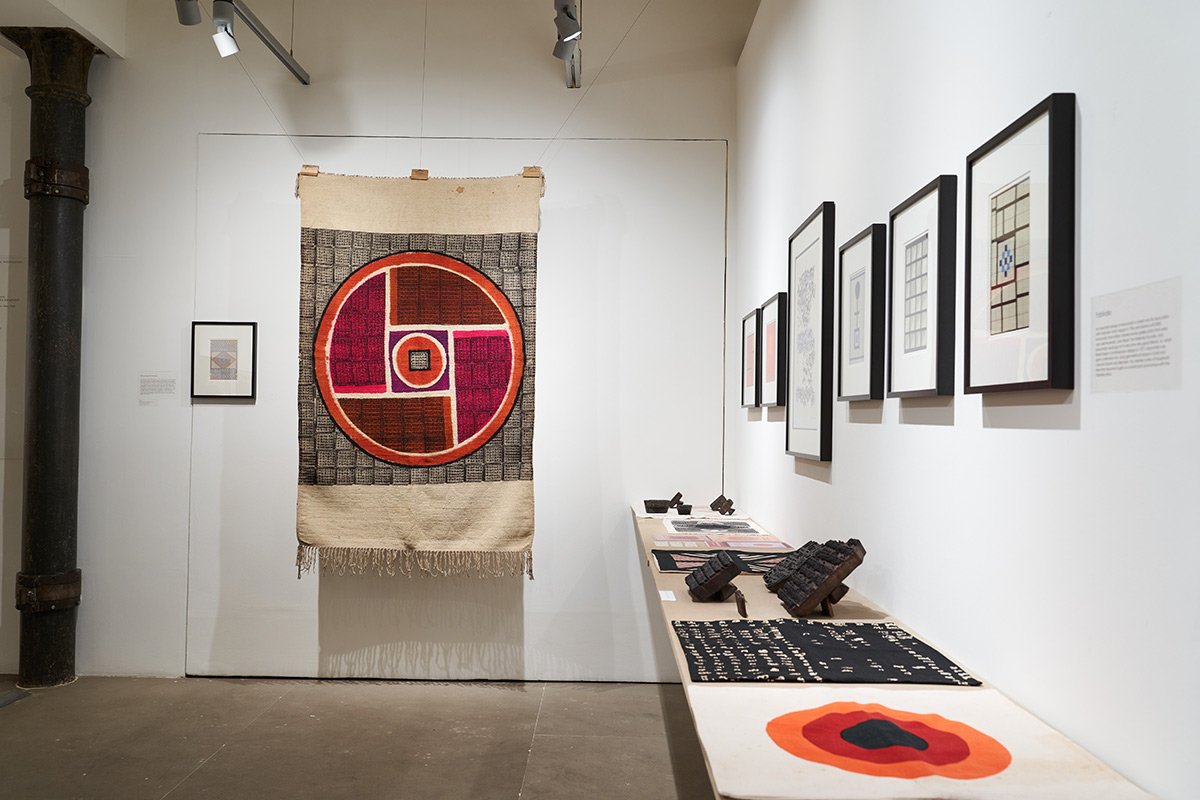
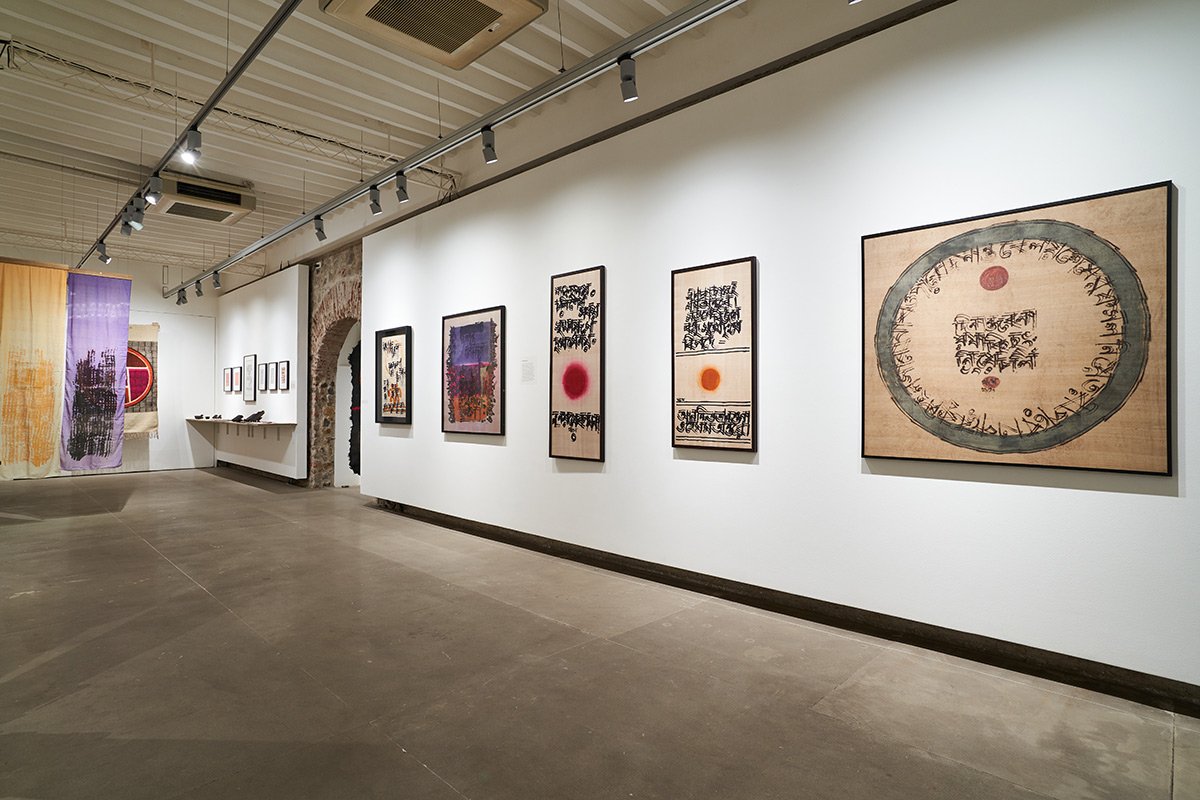
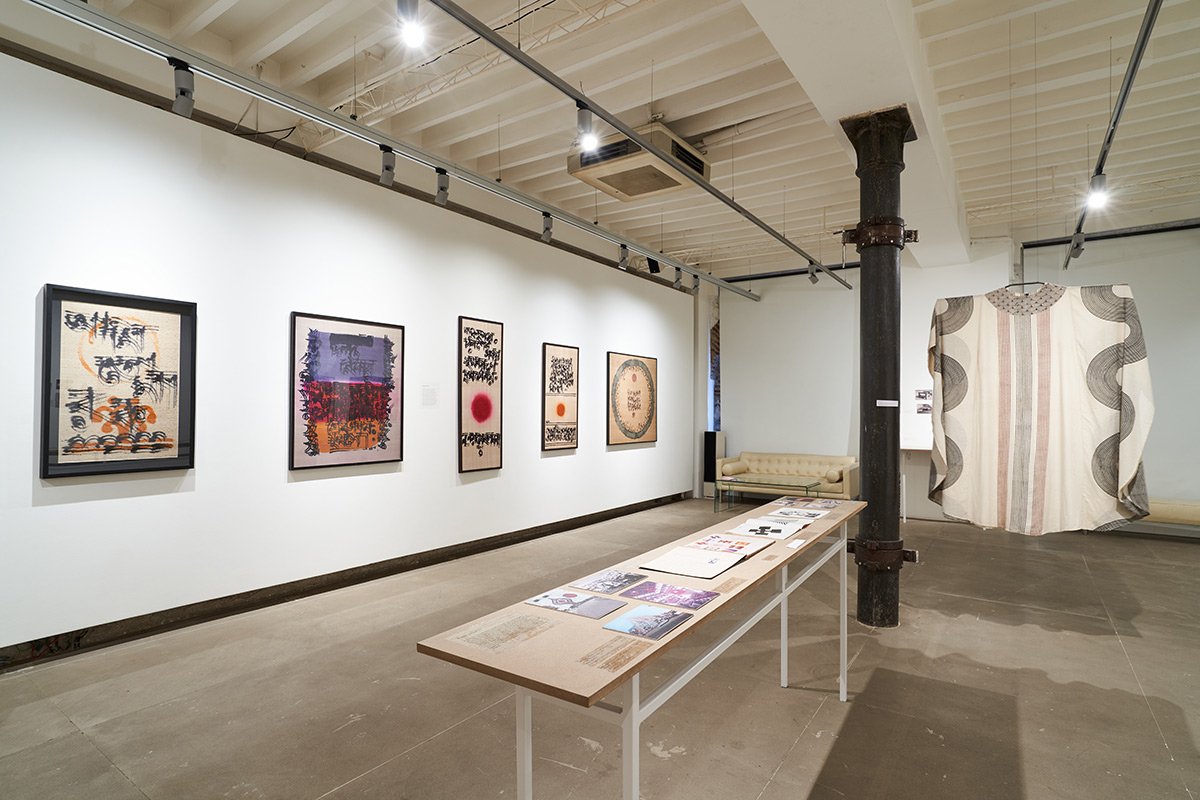
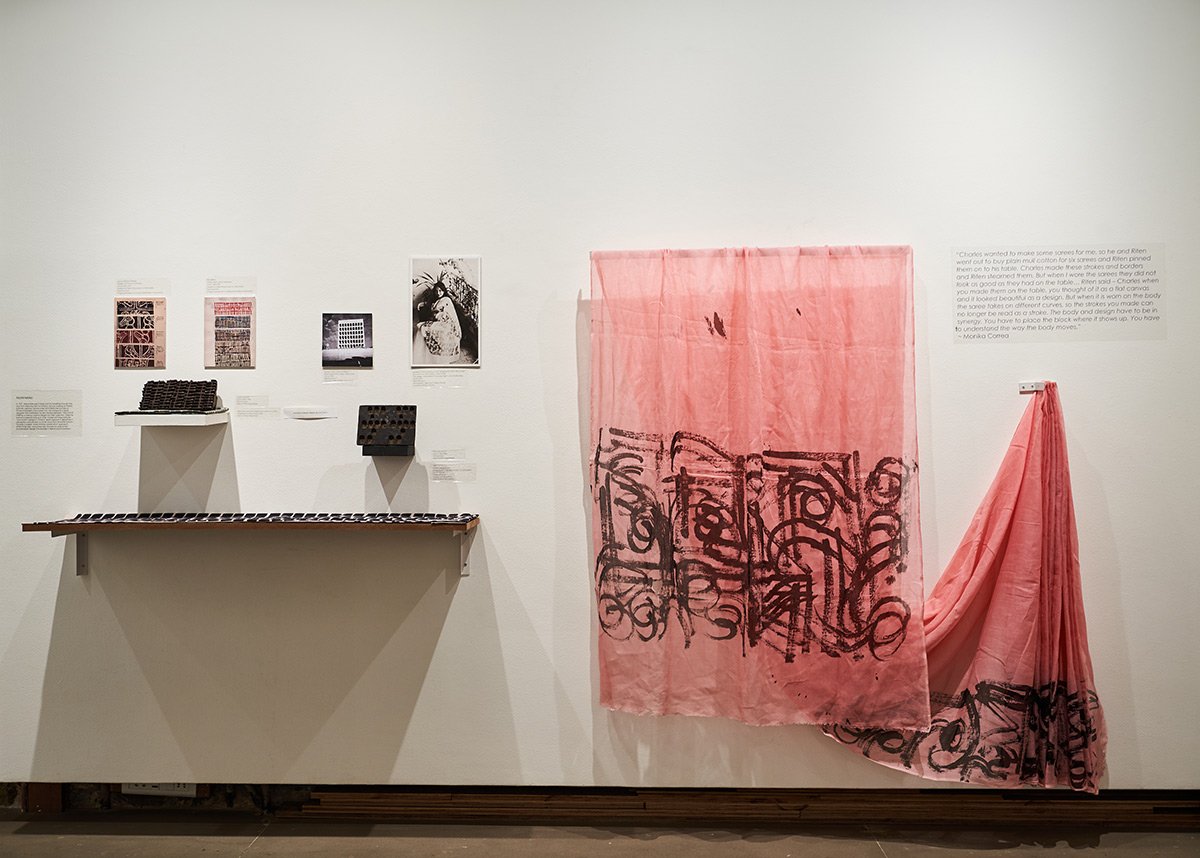
Throughout his long career, calligraphy and text held a great fascination for Mozumdar. Inspired by the Namavali gamchas of U.P. and Bengal, Mozumdar produced several series of designs celebrating text in its purely visual element, divorced from a religious or social context. He also used images of ancient seals and stamps as elements in his designs. For Mozumdar, the boundaries between the fine arts and the functional arts were porous. Mozumdar was ahead of his time in employing visual exegesis towards the creation of new design perspectives.
His work was in high demand and sold through various outlets in India. By 1969, Mozumdar was a name to be reckoned with, and counted Prime Minister Indira Gandhi amongst his clientele. Between the 1960s-1980s, he was also consulted for numerous public sector companies and private firms.
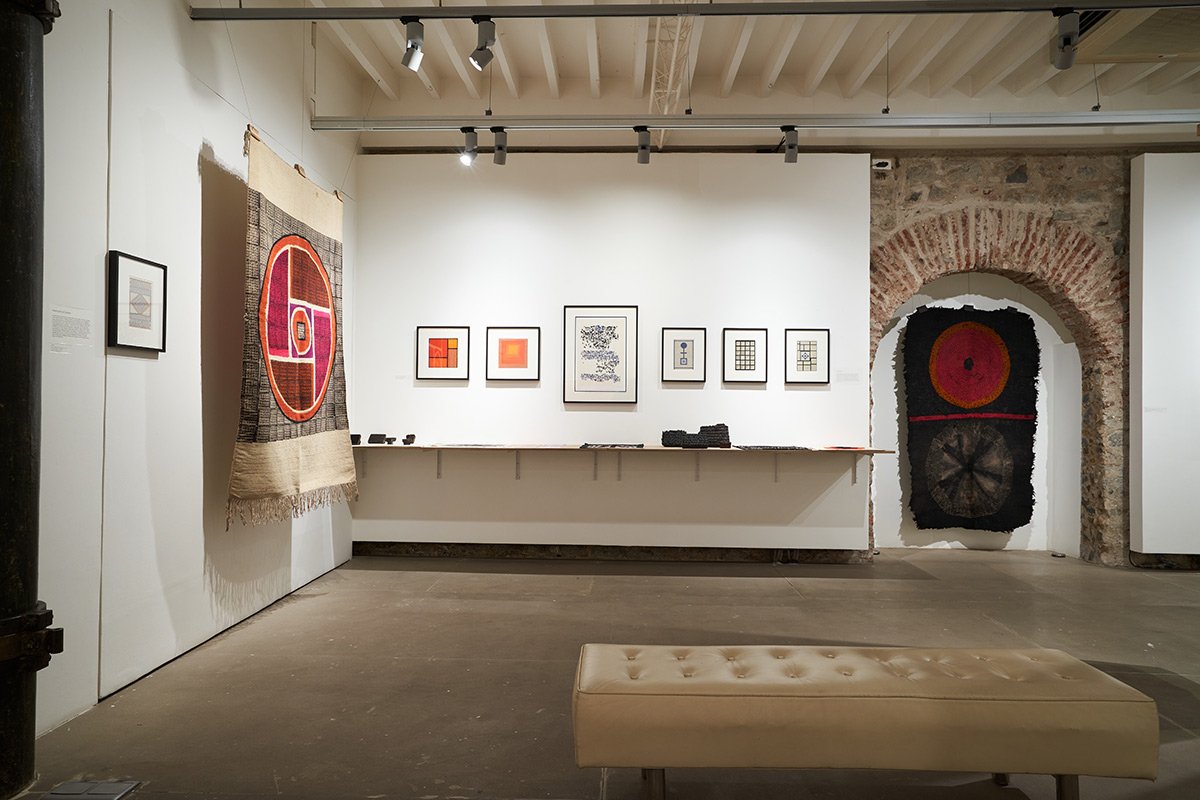
In his capacity as a design advisor to the All India Handicraft Board (AIHB), Mozumdar worked tirelessly to revive the jalee (latticework) work from Saharanpur in Utter Pradesh, and the ivory inlay furniture industry from Hoshiarpur in Punjab. As further proof of his ingenuity, Mozumdar researched and integrated the jalee and archway styles of Indo- Islamic architecture into chairs, tables, screens.
Mozumdar designed a line of furniture which could be called contemporary- classic for Minnie Boga’s TAARU. He also had his own line of furniture. His foray into furniture could be seen as an extension of his experience in wood carving and sculpture. These contemporary designs had noticeable Japanese, Scandinavian and American influences (although occasional indigenous twists included the use of jute to weave seats).
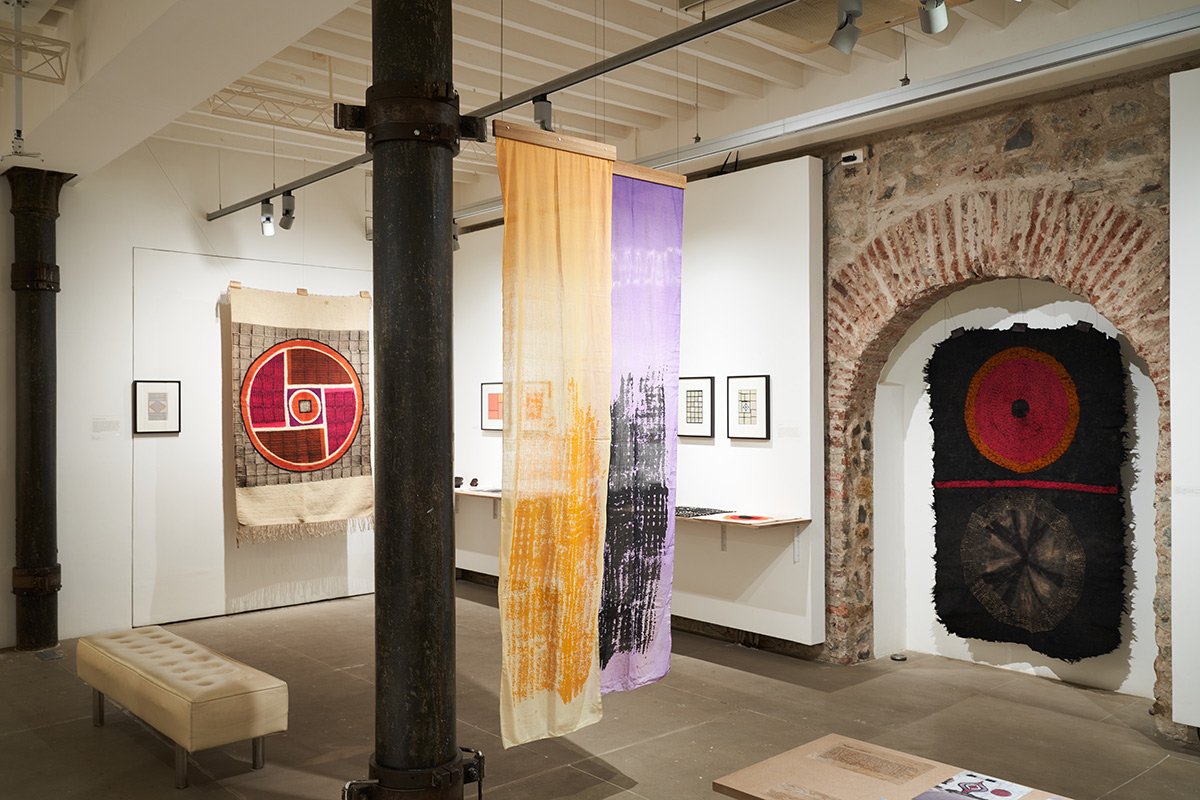
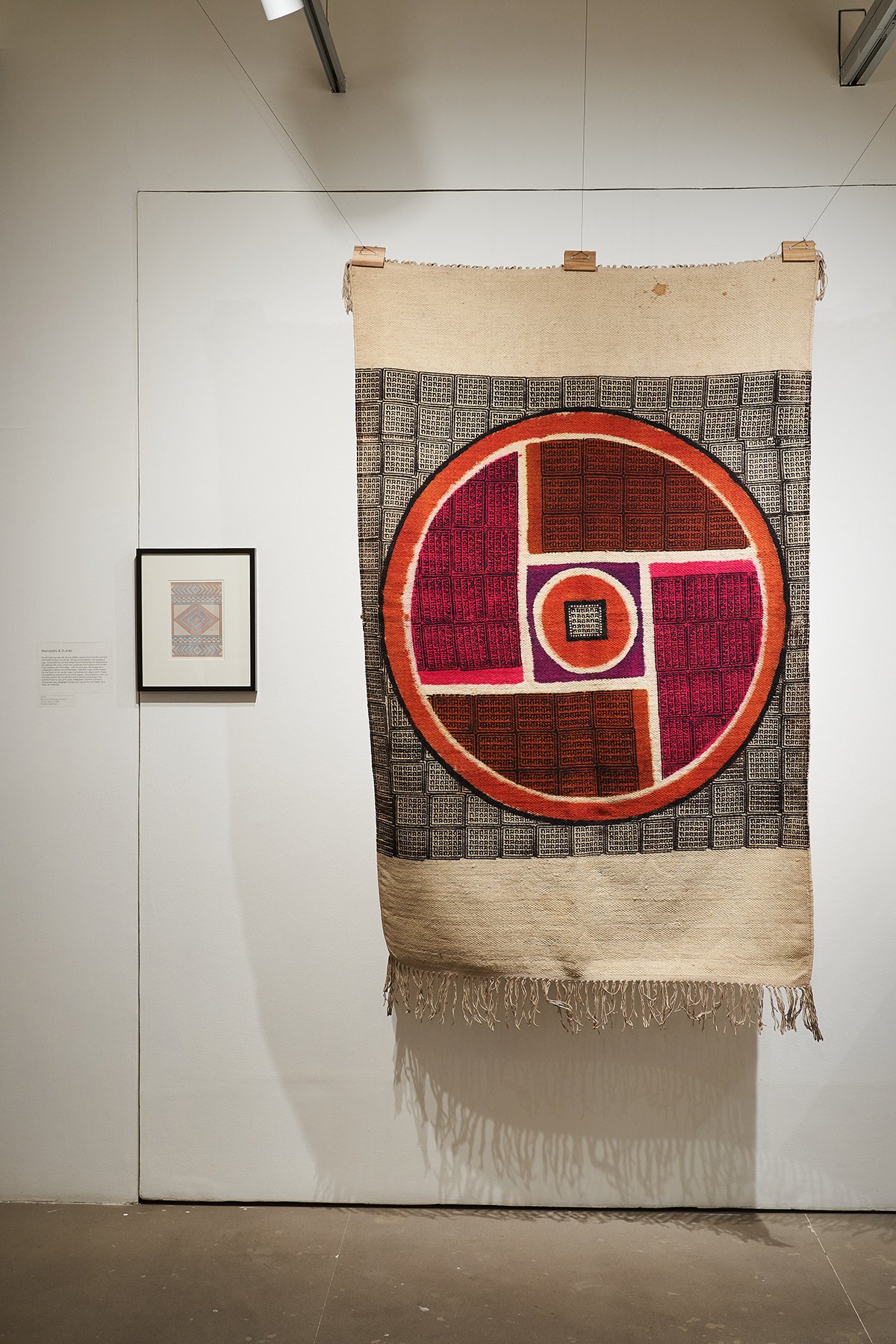
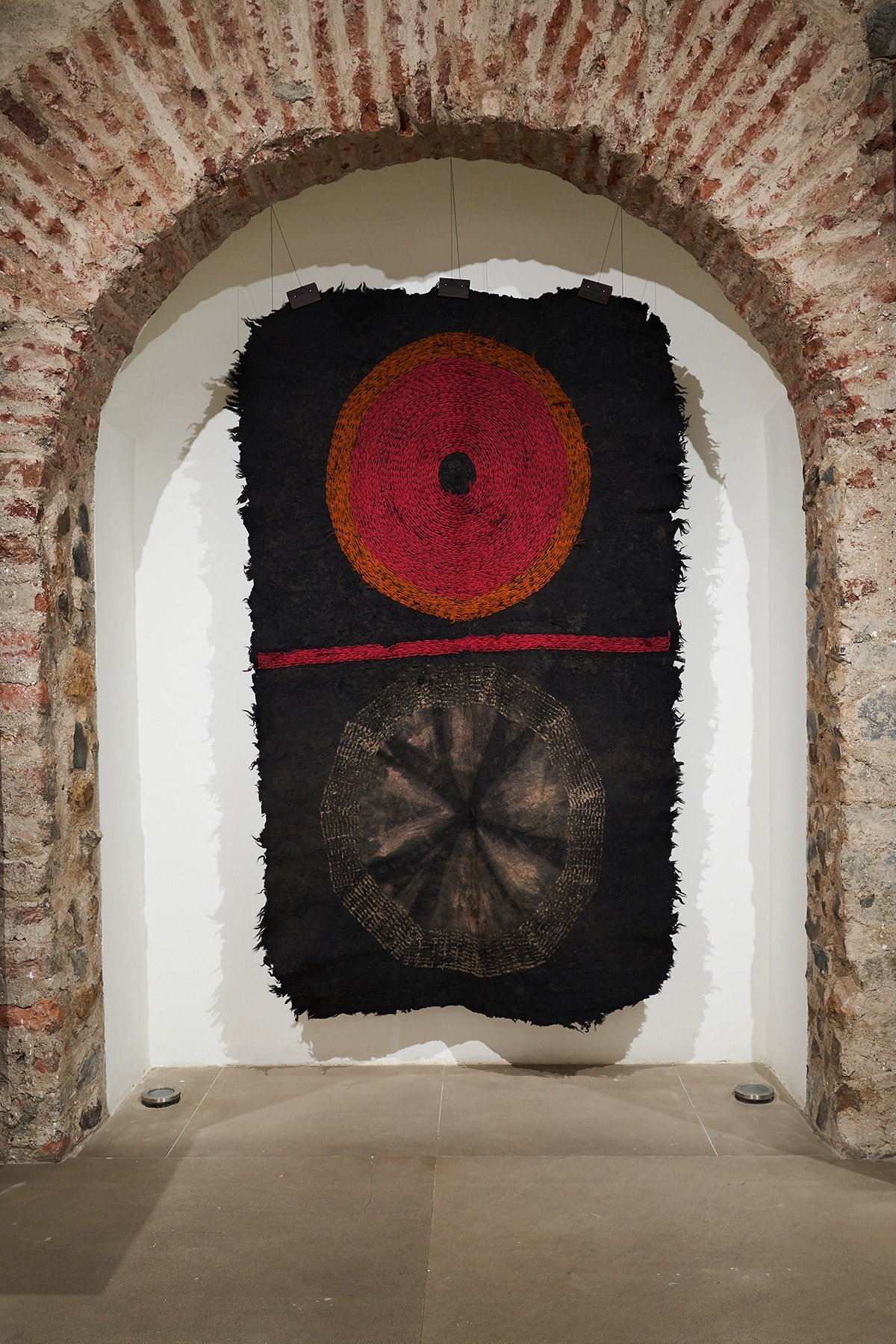
For AIHB, Mozumdar had also worked with Kashmiri floor coverings, felting, and embroidered and applique rugs. Mozumdar re-contextualised and transformed his experience of working with wool, when he combined the traditional Namdah, in an inspired act of synergy, with tie and dye, discharge print, calligraphic blocks and embroidery.
An important phase of Mozumdar’s career was his association with Fabindia which began in 1966 and lasted until 2000. John Bissell, the Fabindia founder, and Mozumdar would go on to become very good friends. So, when Bissell began contemporary designs in 1977, Mozumdar was given carte blanche. Using geometrical shapes in bold and colourful blocks and silkscreen, he created a line of household linen that became hugely successful and synonymous with the Fabindia ethos.
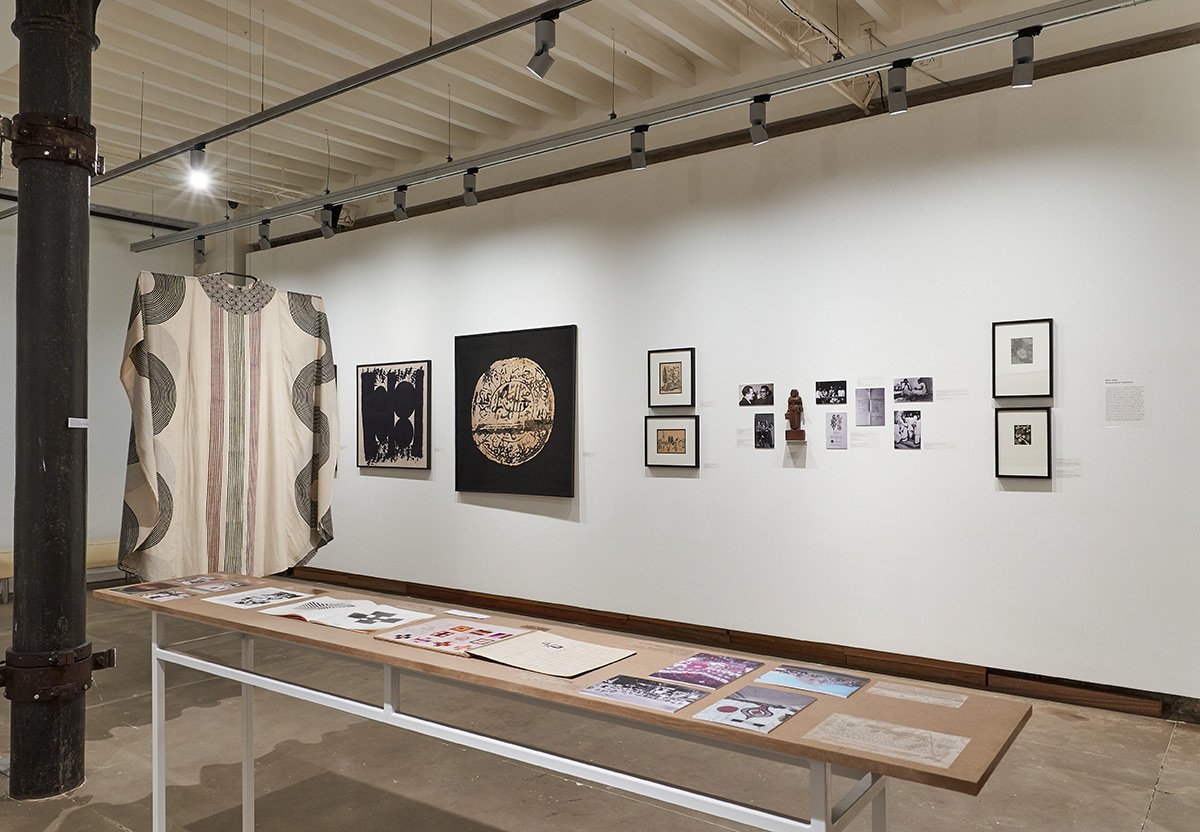
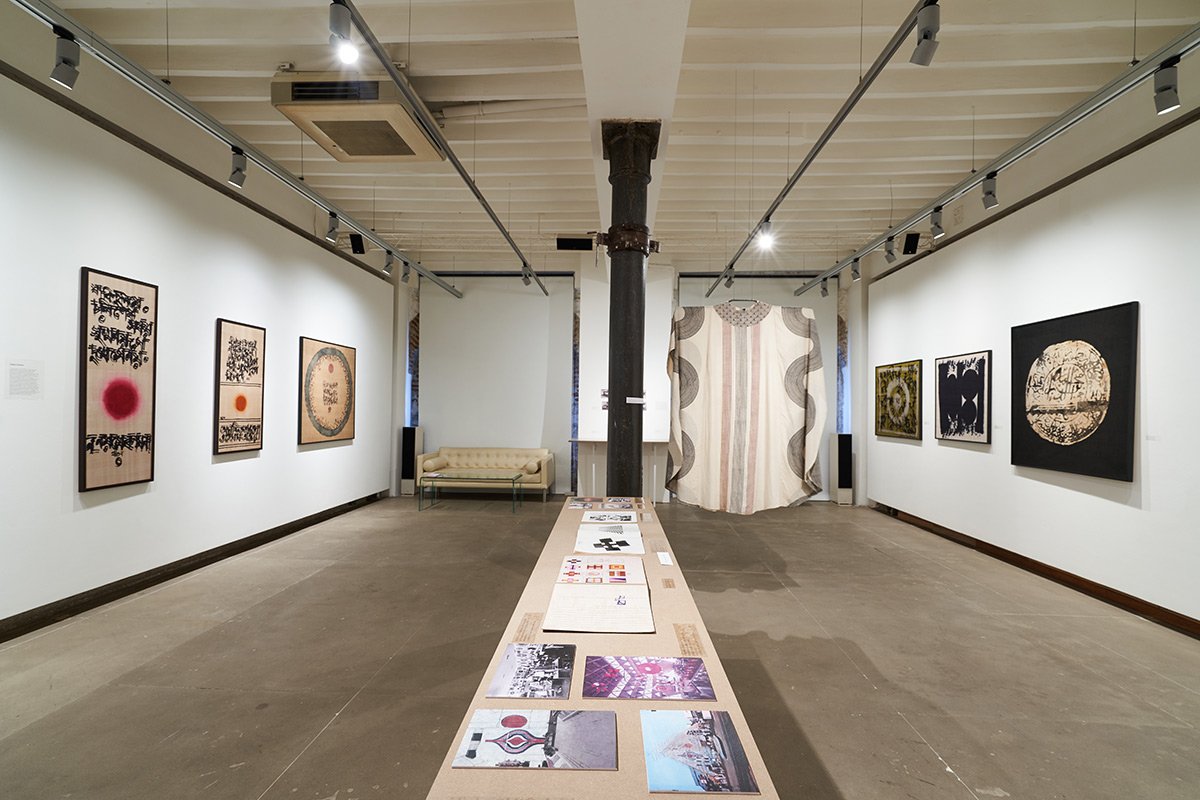
Mozumdar designed garments for labels such as Fabindia; Design Thai, Bangkok; his own label, ‘Riten’; but predominantly for Bharati Sharma’s label, Pallavi. These were exported to the Middle East, Australia and Canada. His clothes were simple, striking and used dramatic geometric motifs to create a contemporary allure.
Mozumdar was always on the lookout for newer challenges, including large scale public commissions. Between 1972 and the late 1980s, Mozumdar collaborated with Sachdev Eggleston Associates on several high-profile and award-winning projects such as the 1972 Third Asian Trade Fair, Bharat Heavy Electricals Ltd. (BHEL) Pavilion, the Asia’72 Hall of Nations at Pragati Maidan Delhi. Architects and engineers he enjoyed working with included Jasbir Sachdev, Rosemary Eggleston, Ram Sharma, Rajinder Kumar, Raj Rewal and Ravi Sikri.
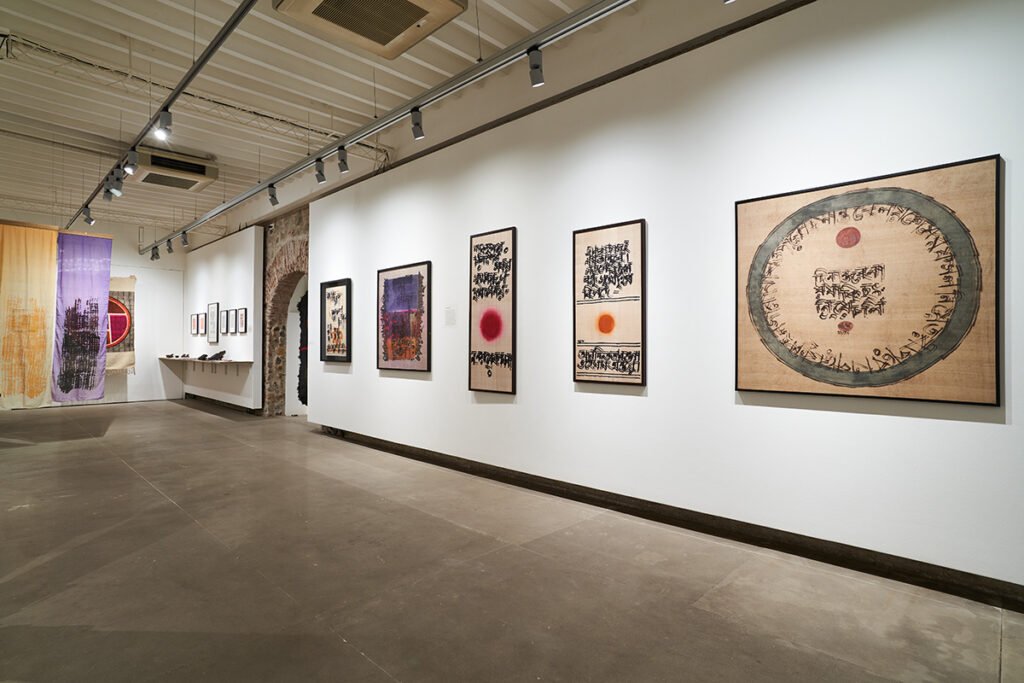
His return to Santiniketan in 1988, also marked Mozumdar’s return to art. He created a series of paintings made with acid dyes on silk with a drop shadow effect to clusters of calligraphic script. Mostly monochromatic, and sometimes relieved at times by splash of red or blue, these works exhibit Mozumdar’s lifelong preoccupation with text. However, unlike his designs which primarily used text as a pattern or motif, here Mozumdar’s use underlined certain conceptual preoccupations. He sometimes used excerpts from Rabindranath Tagore’s poems. This independent series, beautiful in its austerity, marks the culmination of Mozumdar’s dynamic and syncretic vision, straddling the spectrum of both the arts and crafts; disavowing categorization.
Riten Mozumdar passed away in 2006 leaving behind an illustrious career spanning five decades. In his lifetime, Mozumdar had worked and exhibited prolifically both nationally and internationally, yet today his immense legacy remains largely forgotten. To redress this lacuna, IMPRINT: Riten Mozumdar foregrounds this pioneering polymath’s narrative which has, with time, been pushed to the margins of documented history.